



Podcasts
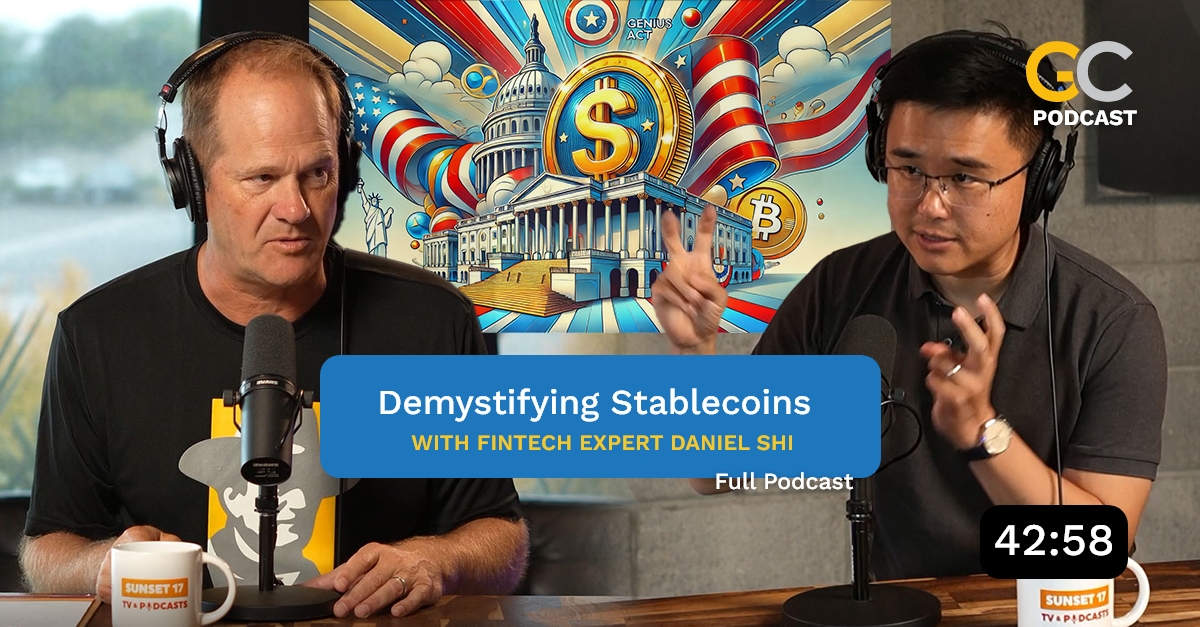
Demystifying Stablecoins with Fintech Expert Daniel Shi
Digital currencies are poised to become the backbone of faster, more flexible transactions worldwide.
Highlights from the Stablecoin Podcast

 Play clip
Play video clip
Play clip
Play video clip
Time: 0:34
Paying people overseas with banks in 2025 - banking hours vs Stablecoins
Timestamps
Demystifying Stablecoins with Fintech Expert Daniel Shi
Than you to fintech expert Daniel Shi for a dive into one of the fastest-growing trends in global finance: Stablecoins.
Daniel’s story begins just down the road in Laguna Hills, before heading off to the Claremont Colleges for his undergraduate studies and later earning a master’s degree from Cornell University. After graduation, he carved out a unique career path in technology and venture capital, spending time in both China and the Bay Area before joining a tiny startup in 2016 called Remitly—then fewer than 50 people strong.
Over the next eight years, Daniel witnessed explosive growth firsthand. Remitly expanded to more than 3,000 employees, opened offices across the globe – which included a move to London – and was fortunate to be there when Remitly went public in 2021. By 2024, ready for a new chapter, Daniel stepped away to pursue angel investing, a high-risk, high-reward way of supporting early-stage companies.
Stablecoins
If you’re in the cross-border payments business, Daniel says, you can’t ignore the rise of Stablecoins. But before diving in, we unpacked what exactly Remitly does. Think Western Union – which has been around for over 200 years – but instead of highly manual telegrams and bricks and mortar, Remitly made its mark as fully digital. Spherically the business of Western Union (e.g. peer to peer payments) but in the palm of your (and the receiver’s’) hands. David rode the Remitly mobile wave and helped to transform how money moves across borders.
Our own connection came when Daniel was looking for a podcast studio, and later, when I noticed on LinkedIn that he was attending a Stablecoin conference in New York. Curious (and admittedly a bit behind on my crypto knowledge), I invited him onto the podcast to explain it to me – and by extension, to all of you.
Stablecoin 101
So… what is a Stablecoin? In simple terms, it’s a cryptocurrency token pegged to a stable asset – most often the U.S. Dollar – on a one-to-one basis. Unlike Bitcoin, whose price can swing wildly, Stablecoins are designed for… well, stability.
The biggest players are:
- Tether (USDT) – the market leader (early early starter)
- Circle (USDC) – the runner-up (recent IPO and USA-based)
These digital tokens are especially powerful for moving money in emerging markets and across borders, where access to U.S. Dollars can be difficult or expensive.
Real-World Analogies
To help make sense of it, we explored some analogies:
- Traveler’s Checks – Like an AmEx traveler’s check, but fully digital and programmable.
- Casino Chips – A token (albeit, a physical token) you exchange for value, but spendable in broader contexts.
- Disney Dollars – Created by Disneyland’s Jack Lindquist, but instead of theme parks, the playground is the global economy.
The Bigger Picture
Stablecoins are more than a payment tool. They are an infrastructure upgrade for how money moves online. We also touched on the Genius Act and what recent U.S. regulations mean for crypto’s future. Daniel introduced the concept of CBDCs (Central Bank Digital Currencies), noting that China’s e-CNY hasn’t taken off as expected, but the global conversation is heating up.
We discussed onramps and offramps, the role of the Bitcoin blockchain, the difference between Stablecoins and payment apps like Venmo or Zelle, and why the U.S. Dollar’s strength underpins so much of this innovation.
Why It Matters
Right now, Stablecoins shine in cross-border money movement, but the technology’s potential is far greater. As Daniel put it, the name says it all – “stability is the value proposition” – and as the open Internet continues to evolve, digital currencies are poised to become the backbone of faster, more flexible transactions worldwide.
I walked away from this conversation with a much deeper appreciation for what Stablecoins can do – and why they’re worth paying attention to.
Huge thanks to Daniel Shi for making time for this show… so I can share with all of you. And, yes, I will have him back in – this is moving very FAST.