



Podcasts
From $25 Million to $6 Billion: The Alliant Blueprint with Greg Zimmer
Greg unpacks the specialization bet that built Alliant's empire, what 50% employee ownership actually looks like at scale, and why he believes AI is the single biggest opportunity for business leaders in the last 20 years.
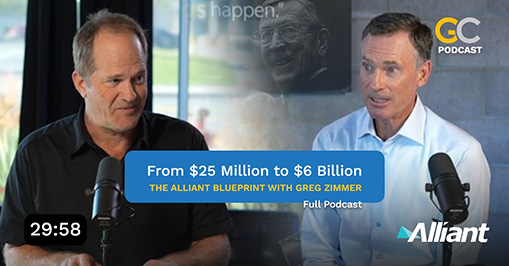
A handful of clips from inside the podcast with Greg Zimmer

Timestamps
Greg Zimmer, President and CEO of Alliant Insurance Services — the largest privately held insurance broker in the world — sat down with GoldenComm’s Jason Lavin for a wide-ranging conversation covering his roots, his philosophy, and the extraordinary growth story behind one of the most quietly dominant firms in the insurance industry.
Zimmer grew up in San Diego, the son of a Navy pilot from North Dakota who stepped off a ship, fell in love with Southern California, and never looked back. It’s a story Greg tells with visible pride. A tight-knit family of five siblings, Midwestern values transplanted to the coast, and a competitive spirit that never found an off switch. “I’ve never learned the chill pill part of it,” he laughed, describing a lifelong inability to sit still as a feature, not a bug.
His academic path was distinctly Bruin blue. After visiting UCLA’s campus as a teenager and essentially claiming it on sight, Zimmer went on to complete both his undergraduate degree and a full-time MBA from UCLA’s Anderson School of Management — an institution that would ultimately claim four of the Zimmer brothers, as well as Zimmer’s wife and his older brother’s wife. He credits the full-time Anderson commitment over the part-time path many working professionals take as one of the best decisions of his career. “I would see these poor guys coming in at 8 o’clock at night after working 10-hour days,” he recalled. No regrets.
His early career began with a lucky accident: a bank hired him to figure out the company’s first personal computer, a machine collecting dust in the mailroom (no one had turned on). That role in corporate finance at Security Pacific Bank — later absorbed into Bank of America — launched a career that has always leaned toward business strategy over pure accounting, toward systems over spreadsheets. “I was invaluable because nobody else knew how to use the thing,” Zimmer said with a grin.
Zimmer’s path to Alliant came through one of those personal connections that sounds improbable until it isn’t. Greg’s junior high school basketball coach (and father’s best friend), Jack Warnock, was a producer at what was then the Robert F. Driver Company, the firm that would eventually become Alliant. Warnock, by Zimmer’s account a gifted salesperson and someone he genuinely looked up to, made a cold call that changed the trajectory of Greg’s career. A reluctant meeting followed with Chairman Tom Corbett, one thing led to another, and Zimmer joined the firm. That was 1998 — 28 years ago. Warnock passed away some years later, but his influence is clearly still felt.
At the time of that 1998 buyout, led by Tom Corbett, the firm had roughly $20–25 million in revenue and about 100 employees operating out of two California offices. The contrast between them told the whole story. San Diego was a generalist, middle-market operation growing at industry rates with industry margins. Newport Beach, where Corbett and Ralph Hurst had built a laser-focused public agency practice, was growing four times faster and generating meaningfully better margins. The strategic conclusion was clear: go build a lot more of Newport Beach.
That conviction became the organizational foundation. Alliant didn’t pursue specialization for its own sake — Zimmer is direct about what it actually produces: faster growth, better margins, and stronger career development for the people inside the business. One vertical grew naturally from another: public agencies led to tribal nations, which surfaced healthcare exposure, which spawned a real estate practice. “It was like branches very naturally growing off a tree,” Zimmer said. Today, with close to $6 billion in revenue and between 14,000 and 15,000 employees, that tree has grown considerably.
The firm’s leadership architecture is itself a testament to the acquisition strategy. Peter Carpenter, now Alliant’s COO, came through the 2008 acquisition of ClearPoint — a Seattle-based employee benefits consulting firm he co-founded and led as CEO. That’s not a hire; that’s a founder choosing to bring his life’s work into the Alliant fold.
Then there’s Peter Arkley, who joined in 2011 after serving as CEO of the construction operations at Aon, one of the world’s largest insurance brokerages. Arkley arrived with a mandate to consolidate the premier construction risk management talent in the country under one roof — and delivered. He also forged a landmark relationship with USC to create a dedicated risk management program, complete with a building bearing his name. Zimmer jokes about wishing UCLA had gotten there first, but the point isn’t the rivalry — it’s that the people Alliant attracts don’t just do their jobs. They build things that last.
The acquisition pattern extends further down the leadership roster, and it’s worth noting that calling out names here is inherently subjective. Alliant’s bench runs deep, and there are many hands on the oars. But Bill Mecklenburg earns a mention here for a personal reason: Jason had met him previously, and that conversation is part of what sparked this very interview. Mecklenburg’s firm was acquired by Alliant. Bill and his partner had built a niche business that included insurance solutions for residential fix-and-flip investors, people owning 20, 30, or 40 homes at a time. That specialty fit seamlessly into the Alliant model. Today he oversees all of Alliant’s MGA operations, a scope far larger than where he started. His story is a case study in what Alliant’s culture does to motivated people: it amplifies them.
That upward trajectory of energy — what Jason called the “mojo going up” — isn’t accidental. Alliant is approximately 50% employee-owned through direct equity, not an ESOP. Zimmer is emphatic that at Alliant’s scale, there is nothing comparable in the industry. The single largest investment many of their employees hold is their own Alliant stock. When the company wins, they win. That alignment, combined with a team-first culture that quietly removed a lobby shrine honoring individuals in favor of something more collective, says everything about how Zimmer thinks about leadership.
The conversation closed on artificial intelligence, and Zimmer showed no hesitation.
“It’s not optional.
It’s not going away.
And it will only get exponentially better.”
He sees AI not as a job threat but as the most exciting opportunity for business leaders in the last 20 years… “It’s an opportunity for all of us to be at the starting line at the same time.”
For a man who has never once looked for the chill pill, that’s not a challenge… that’s an invitation.
Let the games begin.