



Podcasts
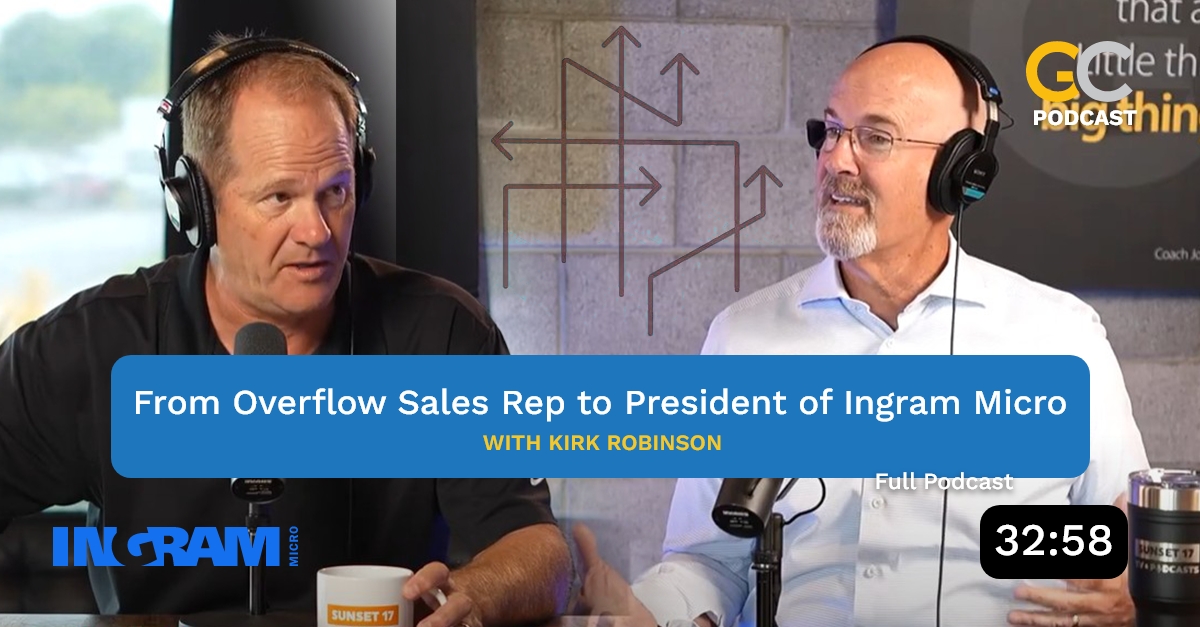
From Overflow Sales Rep to President of Ingram Micro with Kirk Robinson
How does one climb the ladder (or in Kirk's case, climb the lattice) from entry level to president... watch and listen and find out how.
 Play clip
Play video clip
Play clip
Play video clip
Time: :51
Started at "the very bottom" and retired in charge of $30B in revenue


Timestamps
From Overflow Sales Rep to President of Ingram Micro: A Conversation with Kirk Robinson
On this episode of The GoldenComm Podcast, host Jason Lavin welcomed his neighbor and longtime friend, Kirk Robinson, for a conversation that combined career lessons, personal stories, and insights into leadership at the highest level. What made the interview especially unique is that Jason and Kirk’s friendship began not in an office, but on a service trip in Tecate, Mexico.
The two had spoken only briefly by phone before joining a group of volunteers, organized by their mutual friend John Somers, to build a home. They spent two days working side by side, and over breakfast on the third morning, discovered through their wives’ conversation that they actually lived in the same neighborhood. From that serendipitous beginning grew both a friendship and today’s conversation—one that traces Kirk’s path from entry-level sales to leading a $30 billion company.
From Hicksville to San Diego
Kirk grew up in Hicksville, Long Island, about an hour east of NYC. His father worked at Shell Oil in the legendary Rockefeller Plaza. During Kirk’s senior year of high school, his father retired and the family relocated to San Diego. Though the move was unexpected, Kirk quickly knew he wanted to build a life in California.
He began college in San Diego but left before finishing. Years later, he promised his future father-in-law he would complete his degree, which he ultimately did… attending night school while working full-time at Ingram Micro. That commitment to personal growth and keeping promises would become a hallmark of his career.
The First Break at Ingram Micro
Like many young professionals, Kirk’s first jobs were in restaurants. His break came when he joined Ingram Micro as an “overflow sales rep.” In that role—before the internet era—his phone would only ring when every other salesperson was busy. His task was simple: answer and try to sell computers.
What might sound like a dead-end role turned out to be a launchpad. Ingram was already a multi-billion-dollar company at the time, and the energy of the booming tech industry made it an exciting environment. Within six months, Mark Mahoney, a manager at Ingram, gave Kirk his first big opportunity, assigning him to cover a sales desk for a colleague on maternity leave.
It was in that same office that Kirk sat next to Ken Carr, who introduced him to his sister, Cheryle Carr. Cheryle would later become Kirk’s wife—now of over 30 years. As Kirk said during the podcast, he has enjoyed his career at Ingram “for multiple reasons.”
Learning to Lead
As the company grew, Kirk moved up to senior account executive, managing large clients. But his eyes were on leadership, which required a skill he did not yet possess: public speaking. Recognizing the gap, he invested in learning. Two key figures played pivotal roles: Dave Yewman, a speaking coach who helped Kirk become an effective communicator, and Dennis Crupi, who continually pushed him outside his comfort zone and encouraged him to become a better storyteller.
Kirk’s growth mindset was also shaped by an article he read about Nokia’s CEO, who rotated executives through different departments. Inspired, Kirk asked to move into marketing. That bold step opened a new chapter.
Breaking Ground in Business Intelligence
One of the most pivotal opportunities of Kirk’s career came when the CIO and head of marketing asked him to work with UCI interns on “this thing called business intelligence.” The project was to build a dashboard that would tell salespeople the best time to call a customer—an idea that was groundbreaking at the time.
When the CIO later left the company, Kirk approached the president and asked to lead the initiative himself. The answer was yes. Along the way, Kirk was influenced by Thomas Davenport’s book Competing on Analytics, which explored how industries like casinos and credit card companies leveraged data for competitive advantage.
To grow the project, Kirk recruited Susan Chui, who became a key hire in building a 25-person team dedicated to analyzing order data and turning insights into action. That work not only accelerated Kirk’s career but also positioned Ingram Micro at the forefront of data-driven sales.
From the Classroom to the Executive Suite
After six successful years in marketing, Kirk was selected to attend executive education programs at both UCI and Stanford University, alongside other Ingram leaders. Those experiences prepared him for the top levels of management.
Among his peers was Paul Bay, who is now the CEO of Ingram Micro. Paul and Kirk rose through the ranks together, often tackling parallel challenges. Paul’s vision of restructuring Ingram to expand beyond traditional distribution and into value-added services became one of the company’s most important strategic shifts. Kirk was part of executing that vision, eventually serving as EVP and President of Ingram Micro, North America.
Along the way, Kirk also had a friendly professional rivalry with Tim Ament. The two often competed for the same promotions, but rather than creating tension, it sharpened their skills. They supported one another, learned from each other, and became stronger leaders as a result. As Kirk emphasized, no one reaches the top without the support of many people.
Retirement and Reinvention
After decades of service, Kirk retired from Ingram Micro. But retirement did not mean slowing down. Today, he has taken on a new mission: helping others build meaningful careers through his company, KPR Executive Coaching (kprexecutivecoaching.com). His guiding principle, one that shaped his own career, is simple yet profound: Get comfortable being uncomfortable.
Lessons in Leadership
Kirk’s story is one of persistence, adaptability, and courage to embrace discomfort. From answering overflow calls to leading a $30 billion enterprise, his career demonstrates the power of saying yes to opportunities, learning relentlessly, and surrounding yourself with mentors and peers who challenge you.
As Jason closed the conversation, he reflected on how fortunate he has been to spend so much time with Kirk Robinson. “He’s the real deal,” Jason said. And for anyone looking for guidance on leadership and growth, that is no exaggeration.